KOREAN HOME COOKING
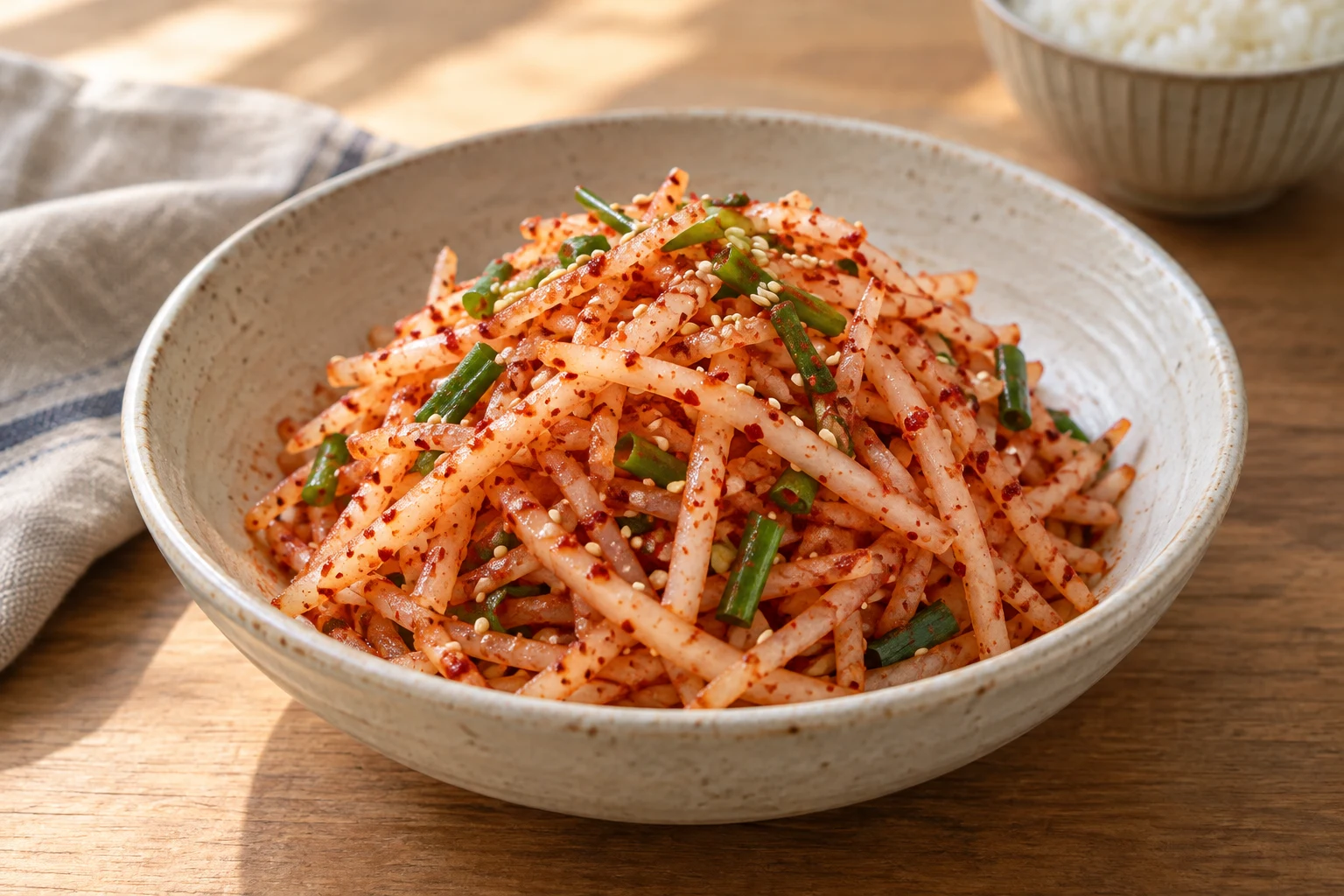
Yunjumo Musaengchae (윤주모 무생채): Korean Radish Salad
윤주모 무생채 · Yunjumo Musaengchae
Crisp Korean radish matchsticks are gently dressed with coarse gochugaru, scallion, green plum syrup, saeujeot, and anchovy fish sauce for a bright, savory banchan.
Editorial guidance updated September 16, 2026 · Not a claim of kitchen testing
QUICK ANSWER
What to know before you cook
Crisp Korean radish matchsticks are gently dressed with coarse gochugaru, scallion, green plum syrup, saeujeot, and anchovy fish sauce for a bright, savory banchan.
Yunjumo Musaengchae (윤주모 무생채) takes about 20 minutes and makes 6 servings. It is rated easy and the finished dish is medium as written. For mild heat, use 2 teaspoons/about 5 g mild coarse gochugaru; for hot, add 1/2 teaspoon fine gochugaru. Do not replace gochugaru measure-for-measure with cayenne.
The key cooking cue: Following the radish from top to root cuts with its long fibers, which helps the strands stay snappy and shed less water. Keep the sticks even so they season at the same rate.
WHY THIS DISH MATTERS
A little cultural context
Musaengchae is a fresh, quick-seasoned radish banchan rather than a long-fermented kimchi. This broadcast version, named for the cook known on air as Yunjumo, skips advance salting and slices the radish with its grain to protect its crunch. Saeujeot and anchovy fish sauce build the layered savoriness familiar in Korean kimchi seasoning.
INGREDIENTS
What you'll need
Both systems are shown so you can cook without converting.
COOKING WEBTOON
Cook it panel by panel
A quick visual memory guide for the whole recipe.
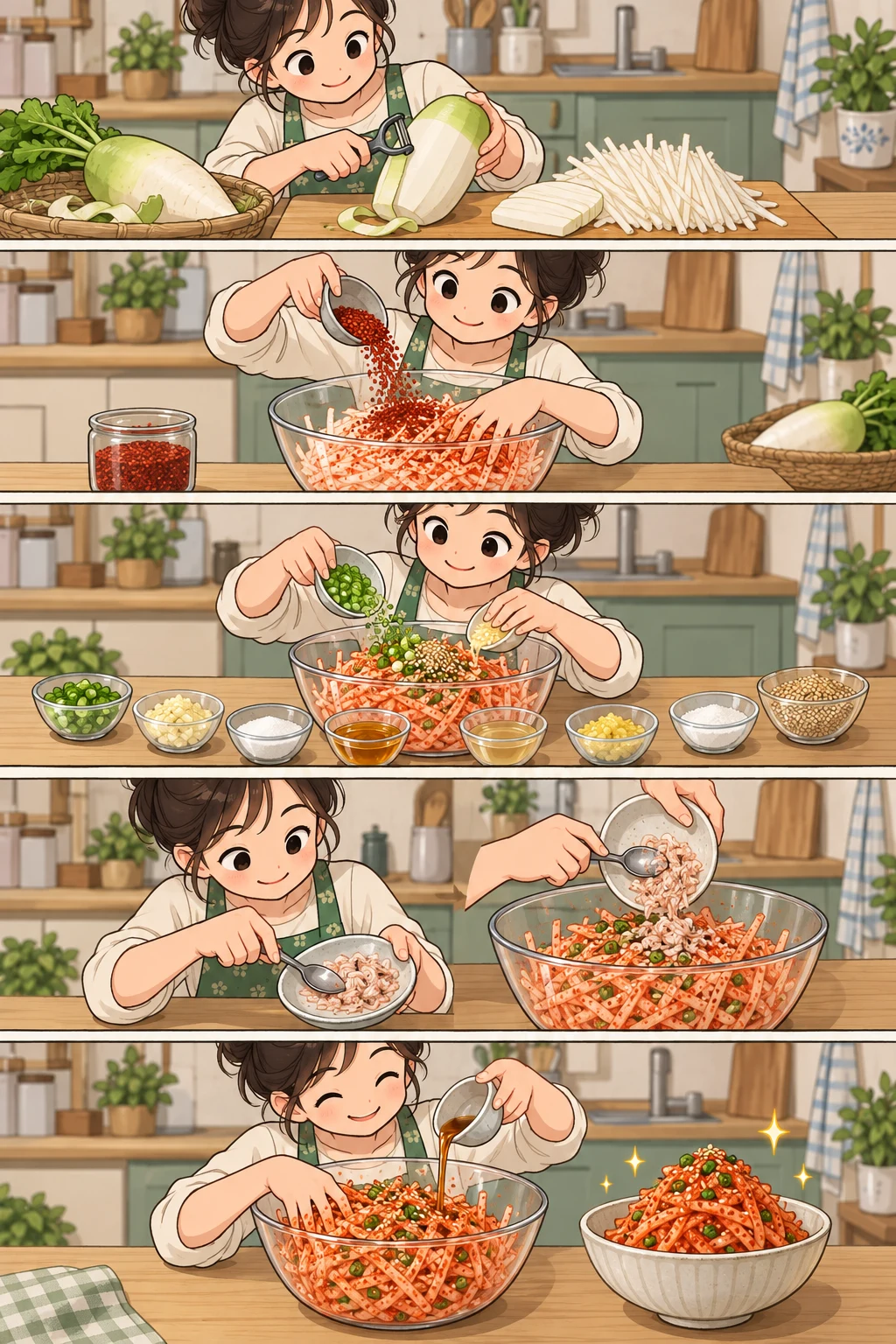 1
1Cut with the grain
8 minPeel the radish, then cut it from green top toward root into thin matchsticks so the strands stay crisp and release less water.
- 2
Color with gochugaru
1 minSprinkle coarse gochugaru over the radish and fold gently until the white strands are evenly pale red.
- 3
Add the seasonings
2 minAdd scallion, garlic, sugar, hamcho salt, ginger, maesil-cheong, vinegar, and sesame; toss without squeezing.
- 4
Crush the saeujeot
1 minMash the salted shrimp into small pieces with the back of a spoon, then distribute it through the salad.
- 5
Finish with fish sauce
1 min + 5 min restAdd anchovy fish sauce, give the salad one final gentle toss, and rest briefly before serving.
AI-assisted illustration. Follow the written recipe below for exact measurements, the lower-salt option, and safe storage.
DIRECTIONS
How to make it
- 01
Peel and cut with the grain · 8 minutes
Peel the radish and trim the ends. Cut it lengthwise from the green top toward the root into thin slabs, stack two or three slabs, then slice in the same direction into matchsticks about 1/8 inch/3 mm thick. Put them in a wide mixing bowl.
- 02
Color the radish · 1 minute
Sprinkle over the coarse gochugaru. With clean hands or salad servers, lift and fold the radish for 30 to 45 seconds, until no dry white patches remain and every strand is lightly stained red. Do not knead or squeeze.
- 03
Add the aromatic seasonings · 2 minutes
Add the scallion, garlic, sugar, hamcho salt, ginger, maesil-cheong, brown rice vinegar, and sesame seeds. Lift from the bottom and fold for 45 to 60 seconds, just until the sugar and salt have dispersed and the scallion is evenly distributed.
- 04
Crush and add the saeujeot · 1 minute
Place the saeujeot on a small saucer and press it repeatedly with the back of a spoon until the shrimp pieces are finely broken up. Scrape all of it into the bowl and fold through the radish until there are no concentrated pockets.
- 05
Finish, taste, and rest · 6 minutes
Pour in the anchovy fish sauce and give the salad 15 to 20 gentle folds. A finished strand should bend but still snap cleanly, look evenly brick red, and taste sweet-tart, savory, and fresh rather than cured. Rest 5 minutes, taste, and add only a small pinch of salt if needed before serving.
COOK WITH CONFIDENCE
Fix common problems
Use the symptom, likely cause, and rescue step while you cook.
The bowl turns watery
Likely causeThe radish was cut across its long fibers, squeezed during mixing, or left dressed too long.
How to fix itDrain only the pooled liquid, fold once, and serve promptly. Next time, cut from green top toward root, toss with a lifting motion, and dress just before the meal.
The salad tastes too salty
Likely causeThe full broadcast salt amount was used before accounting for the saeujeot and fish sauce.
How to fix itFold in more unsalted radish matchsticks. Next time, begin with 2 teaspoons/10 g hamcho or fine sea salt, then adjust only after both seafood seasonings are added.
The radish feels limp
Likely causeThe matchsticks were too thin, the salad was kneaded, or it sat at room temperature.
How to fix itChill for 10 minutes and serve well drained. Keep the sticks close to 1/8 inch/3 mm thick and stop tossing as soon as the seasoning is evenly distributed.
SHOP & SUBSTITUTE
Cook it anywhere
Ingredient swaps
Korean radishUse daikon of the same weight. Daikon is often wetter and less sweet, so cut it slightly thicker, omit the 5-minute rest, and season just before serving.
Hamcho saltUse fine sea salt by weight. Begin with 2 teaspoons/10 g for a lower-salt version, then taste only after the saeujeot and fish sauce are mixed in; kosher-salt volume varies by brand.
Maesil-cheongUse 1 teaspoon mild honey mixed with 1/2 teaspoon rice vinegar for a similar sweet-tart balance.
Brown rice vinegarUse unseasoned rice vinegar or apple cider vinegar. Avoid seasoned sushi vinegar, which adds extra sugar and salt.
SaeujeotFor a shellfish-free version, omit it and add 1/2 teaspoon more anchovy fish sauce after tasting. For a vegan version, use Korean soup soy sauce instead of both seafood seasonings.
Korean pantry guide
A dense, crisp white radish with a green shoulder. It is sweeter and usually less watery than long daikon, especially near the green top.
Search: fresh Korean radish mu green topKorean red pepper flakes with a fruity aroma and moderate warmth; coarse flakes give fresh kimchi-style salads color without turning pasty.
Search: Korean coarse red pepper flakes gochugaruSea salt blended with dried glasswort, a salt-tolerant coastal plant. It brings mineral salinity but should still be measured as salt.
Search: Korean glasswort salt hamcho sogeumA sweet-tart syrup made by macerating green maesil plums with sugar, often used to round out Korean dressings and marinades.
Search: Korean green plum syrup maesil cheongTiny salted fermented shrimp used as a concentrated savory seasoning in kimchi, stews, and pork accompaniments.
Search: Korean salted fermented shrimp saeujeotA clear, deeply savory fermented anchovy seasoning commonly used in Korean kimchi and vegetable salads.
Search: Korean anchovy fish sauce myeolchi aekjeotServe it with
- Hot short-grain rice and a fried egg
- Grilled pork or bulgogi
- Seolleongtang, gomtang, or another mild soup
Spice level
Medium as written. For mild heat, use 2 teaspoons/about 5 g mild coarse gochugaru; for hot, add 1/2 teaspoon fine gochugaru. Do not replace gochugaru measure-for-measure with cayenne.
Storage & serving
Serve immediately for the best crunch. Refrigerate leftovers in an airtight container within 2 hours and eat within 2 days; stir before serving and drain only excess pooled liquid. Do not freeze or reheat this fresh salad.
REAL COOK QUESTIONS
Good questions, clear answers
Short answers for substitutions, heat level, make-ahead cooking, and serving.
What can I substitute for Korean radish in Yunjumo Musaengchae (윤주모 무생채)?
Use daikon of the same weight. Daikon is often wetter and less sweet, so cut it slightly thicker, omit the 5-minute rest, and season just before serving.
Is Yunjumo Musaengchae (윤주모 무생채) spicy?
Medium as written. For mild heat, use 2 teaspoons/about 5 g mild coarse gochugaru; for hot, add 1/2 teaspoon fine gochugaru. Do not replace gochugaru measure-for-measure with cayenne.
Can I make Yunjumo Musaengchae (윤주모 무생채) ahead of time?
Serve immediately for the best crunch. Refrigerate leftovers in an airtight container within 2 hours and eat within 2 days; stir before serving and drain only excess pooled liquid. Do not freeze or reheat this fresh salad.
What should I serve with Yunjumo Musaengchae (윤주모 무생채)?
Serve it with Hot short-grain rice and a fried egg, Grilled pork or bulgogi, Seolleongtang, gomtang, or another mild soup.
KEEP COOKING
Related Korean recipes
Chosen by shared ingredients, pantry staples, and cooking style.