KOREAN HOME COOKING
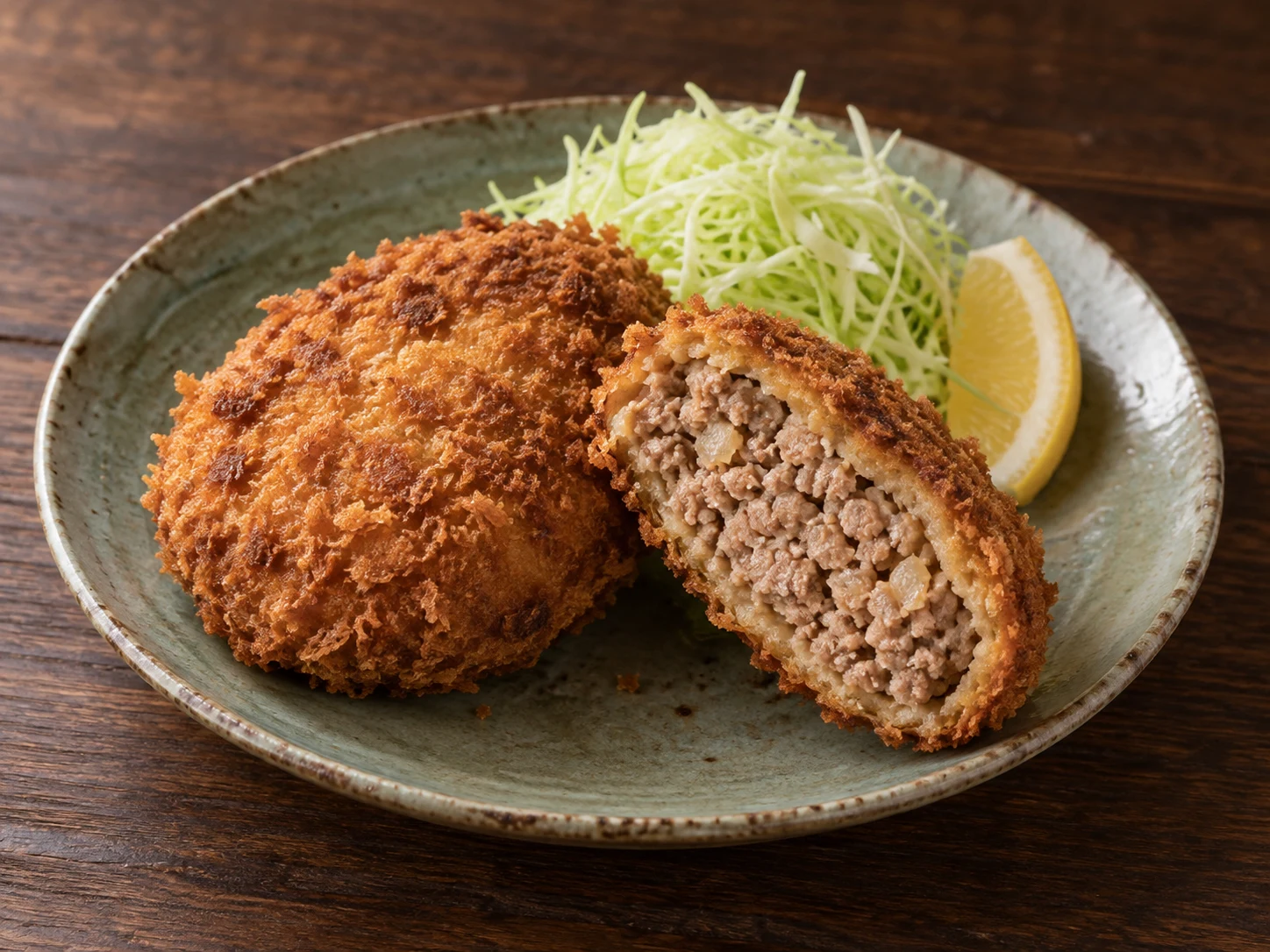
Menchi Katsu (멘치카츠): Crispy Beef-and-Pork Cutlets
멘치카츠 · Menchi Katsu
Juicy beef-and-pork patties, sweet with cooled sautéed onion and warm nutmeg, are wrapped in an airy panko crust and fried until deeply golden.
Editorially reviewed for global home kitchens · Updated September 13, 2026
QUICK ANSWER
What to know before you cook
Juicy beef-and-pork patties, sweet with cooled sautéed onion and warm nutmeg, are wrapped in an airy panko crust and fried until deeply golden.
Menchi Katsu (멘치카츠) takes about 55 minutes and makes 6 servings. It is rated moderate and the finished dish is not spicy as written. The warmth comes from black pepper and nutmeg, not chile. For children, reduce the pepper to 1/2 teaspoon/1 g. For heat, serve gochujang mayo or a chile sauce on the side rather than changing the meat mixture.
The key cooking cue: Warm onion softens the fat in the meat and makes shaping difficult. Keep the pork and beef in the refrigerator while the onion cools.
WHY THIS DISH MATTERS
A little cultural context
Menchi-katsu began as a Japanese yōshoku, or Western-influenced, ground-meat cutlet. In Korea its Japanese name is written 멘치카츠, and the dish appears in restaurant menus, ready-to-cook products, and TV cooking programs alongside Korean-style sauces and banchan. Chef Kouji’s Altoran version uses a pork-heavy blend with a precise small amount of beef, develops springy texture by kneading the chilled meat with salt, and relies on fresh panko for its feathery crust.
INGREDIENTS
What you'll need
Both systems are shown so you can cook without converting.
COOKING WEBTOON
Cook it panel by panel
A quick visual memory guide for the whole recipe.
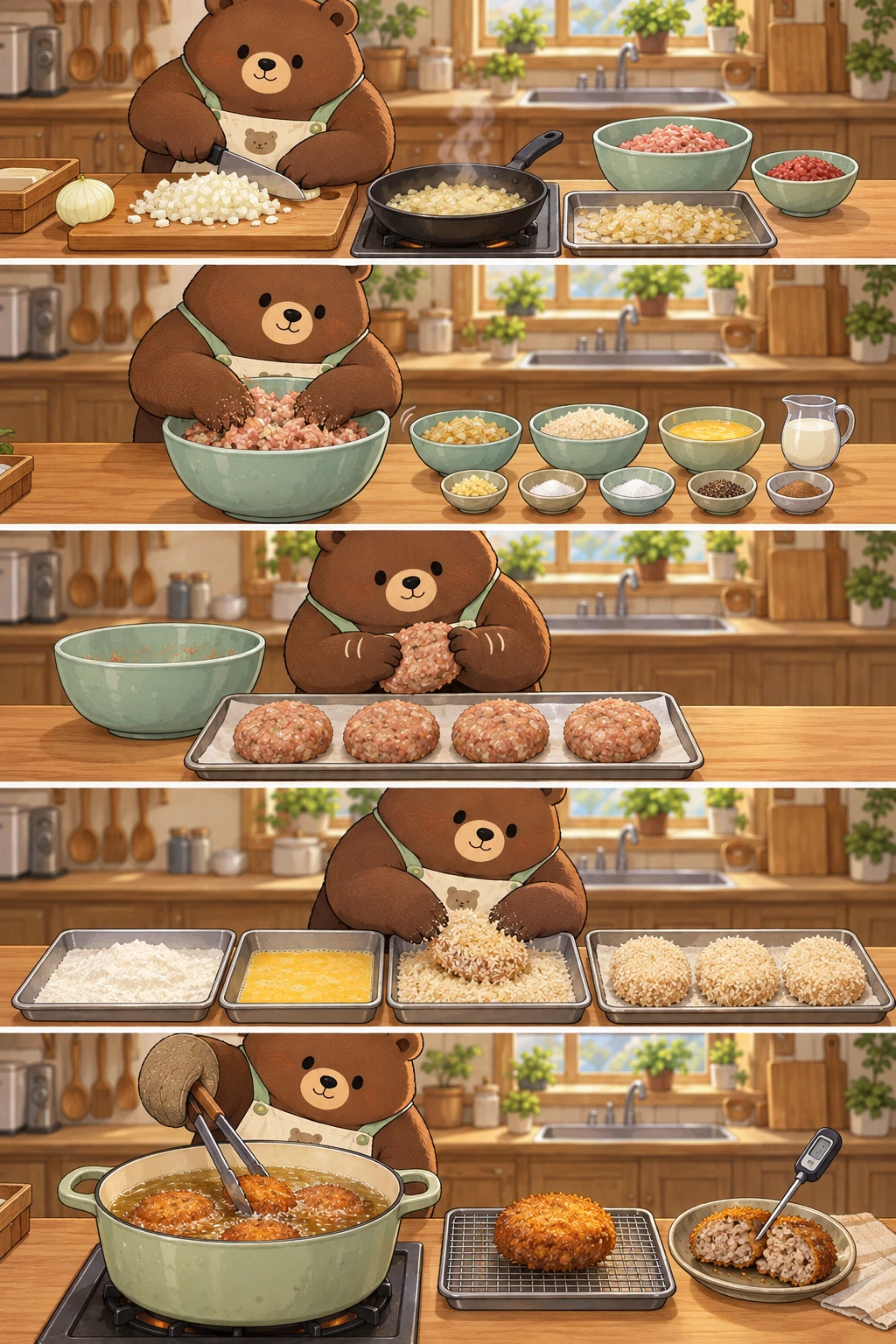 1
1Sauté and cool
15 minFinely dice the onion, cook it until translucent and dry, then spread it out and cool it completely.
- 2
Build the sticky mixture
5 minKnead cold pork, beef, and salt until tacky, then gently fold in the onion, garlic, crumbs, egg, milk, sugar, pepper, and nutmeg.
- 3
Portion and remove air
6 minWeigh 100-gram portions, pass each between your hands to release air pockets, and form thick oval patties.
- 4
Bread every surface
8 minDust lightly with flour, coat with beaten egg, and press fresh panko over the front, back, and edges.
- 5
Set, turn, and rest
7–8 min per batchFry at 340°F/170°C untouched for 2 minutes, turn as the crust sets, cook to 160°F/71°C, then rest on a rack for 2 to 3 minutes.
AI-assisted illustration. Follow the written recipe below for exact measurements, oil temperature, batch size, raw-meat hygiene, and the 160°F/71°C safety check.
DIRECTIONS
How to make it
- 01
Sauté the onion and cool it fully · 15 minutes
Warm 2 teaspoons of the frying oil in a skillet over medium heat. Add the 165 g finely diced onion and cook for 6 to 8 minutes, stirring every 30 to 45 seconds. Stop when the pieces are translucent, lightly golden at a few edges, and no liquid gathers when you clear a path through the pan. Spread the onion thinly on a tray and cool for about 7 minutes, until it no longer feels warm.
- 02
Knead the cold meat, then fold in the seasonings · 5 minutes
Put the chilled pork, beef, and salt in a cold mixing bowl. Knead firmly for 2 to 3 minutes, until the mixture turns tacky, clings to your fingers, and holds together when lifted. Add the cooled onion, garlic, 50 g fresh breadcrumbs, 1 beaten egg, milk, sugar, pepper, and nutmeg. Fold and squeeze gently for about 1 minute, stopping as soon as the additions are evenly distributed.
- 03
Weigh, de-air, and shape · 6 minutes
Set a parchment-lined tray nearby. Weigh out 100 g portions; this batch makes about 6 full patties plus a small cook’s tester, depending on moisture loss from the onion. Pass each portion firmly from one hand to the other 6 to 8 times to push out trapped air, then shape it into a 3/4-inch/2-cm-thick oval with smooth, sealed edges.
- 04
Bread the patties and let the coating settle · 8 minutes
Arrange the flour, remaining beaten egg, and fresh coarse panko in three shallow dishes. Coat one patty at a time: dust it with a thin veil of flour and tap off every loose patch; cover it completely in egg; then press panko onto both faces and all around the edge. Place the breaded patties on a clean tray and rest them for 5 minutes while the oil heats.
- 05
Fry, turn after the crust sets, and rest · 7 to 8 minutes per batch
Heat the oil in a heavy pot to 340°F/170°C; it should be at least 2 inches/5 cm deep and the pot no more than half full. Lower in 2 or 3 patties without crowding. Leave them untouched for the first 2 minutes, exactly as the broadcast directs. When the crust feels firm and pale gold, turn with long tongs. Continue frying, turning once or twice more for even color, for about 5 minutes total. Check the thickest center from the side: it must reach 160°F/71°C. If the crust is ready first, lower the oil to 325°F/165°C and continue until the temperature target is met. Drain on a wire rack and rest 2 to 3 minutes before serving; let the oil return to 340°F/170°C before the next batch.
COOK WITH CONFIDENCE
Fix common problems
Use the symptom, likely cause, and rescue step while you cook.
The crust turns dark before the center is safe
Likely causeThe oil is too hot or the patties are thicker than the recipe target.
How to fix itLower the oil to 325°F/165°C and continue frying gently. Check from the side with an instant-read thermometer; ground-meat cutlets must reach 160°F/71°C.
The coating slips away from the patty
Likely causeLoose flour was left on the surface, the egg wash missed a spot, or the breaded patty went straight into the oil.
How to fix itDust off excess flour, cover every dry patch with egg, press on the crumbs, and rest the breaded patties for 5 minutes before frying.
The cutlets are pale and greasy
Likely causeToo many cold patties dropped the oil temperature below the frying range.
How to fix itFry in small batches and let the oil return to 340°F/170°C between them. Drain on a wire rack instead of paper towels.
SHOP & SUBSTITUTE
Cook it anywhere
Ingredient swaps
Ground pork and beefUse all ground pork or an 80/20 beef blend while keeping the same 394 g total. Ground turkey also works, but cook it to 165°F/74°C and expect a leaner texture.
Fresh soft breadcrumbs in the fillingPulse soft white sandwich bread into crumbs. If using dry panko, use 35 g and soak it in the measured milk for 5 minutes before mixing.
Fresh coarse panko for coatingUse standard dry panko and mist it very lightly with water, toss, and rest 5 minutes so it becomes flexible without turning soggy.
Whole milkUse the same amount of cold water, as the official recipe allows, or unsweetened soy milk.
All-purpose flourUse rice flour or a cup-for-cup gluten-free flour blend. For a fully gluten-free cutlet, confirm the panko and every seasoning are also labeled gluten-free.
NutmegOmit it rather than using a strongly flavored spice blend. A tiny pinch of ground mace is the closest substitute.
Korean pantry guide
Soft, coarse fresh breadcrumbs used for a light, feathery fried crust. The Korean label literally means “moist breadcrumbs”; they are not dry crumbs soaked until wet.
Search: Korean Japanese fresh panko wet breadcrumbs seupsik ppanggaruA breaded ground-meat cutlet associated with Japanese yōshoku cooking and familiar in Korean restaurants, supermarkets, and television recipes.
Search: Korean menchi katsu frozen ground meat cutletThe everyday Korean term for neutral cooking oil. For deep-frying, choose a refined oil with a high smoke point rather than toasted sesame oil.
Search: Korean neutral cooking oil sigyongyu fryingA warm aromatic spice used sparingly in Western-style ground-meat dishes; Korean recipes usually call for only a pinch.
Search: ground nutmeg yukdugu Korean groceryServe it with
- Finely shredded cabbage with a light sesame or rice-vinegar dressing
- Steamed short-grain rice and mild doenjang soup
- Kimchi or yellow pickled radish, with tonkatsu sauce served on the side
Spice level
Not spicy as written. The warmth comes from black pepper and nutmeg, not chile. For children, reduce the pepper to 1/2 teaspoon/1 g. For heat, serve gochujang mayo or a chile sauce on the side rather than changing the meat mixture.
Store & reheat
For make-ahead cooking, refrigerate shaped unbreaded patties for up to 1 day or freeze them on a tray, then wrap and keep for up to 1 month; thaw overnight in the refrigerator before breading. Refrigerate cooked cutlets within 2 hours and keep for up to 3 days. Reheat on a rack in a 375°F/190°C oven or air fryer for 8 to 12 minutes, turning once, until crisp and the center reaches 165°F/74°C. Do not microwave unless texture is unimportant.
REAL COOK QUESTIONS
Good questions, clear answers
Short answers for substitutions, heat level, make-ahead cooking, and serving.
What can I substitute for Ground pork and beef in Menchi Katsu (멘치카츠)?
Use all ground pork or an 80/20 beef blend while keeping the same 394 g total. Ground turkey also works, but cook it to 165°F/74°C and expect a leaner texture.
Is Menchi Katsu (멘치카츠) spicy?
Not spicy as written. The warmth comes from black pepper and nutmeg, not chile. For children, reduce the pepper to 1/2 teaspoon/1 g. For heat, serve gochujang mayo or a chile sauce on the side rather than changing the meat mixture.
Can I make Menchi Katsu (멘치카츠) ahead of time?
For make-ahead cooking, refrigerate shaped unbreaded patties for up to 1 day or freeze them on a tray, then wrap and keep for up to 1 month; thaw overnight in the refrigerator before breading. Refrigerate cooked cutlets within 2 hours and keep for up to 3 days. Reheat on a rack in a 375°F/190°C oven or air fryer for 8 to 12 minutes, turning once, until crisp and the center reaches 165°F/74°C. Do not microwave unless texture is unimportant.
What should I serve with Menchi Katsu (멘치카츠)?
Serve it with Finely shredded cabbage with a light sesame or rice-vinegar dressing, Steamed short-grain rice and mild doenjang soup, Kimchi or yellow pickled radish, with tonkatsu sauce served on the side.
KEEP COOKING
Related Korean recipes
Chosen by shared ingredients, pantry staples, and cooking style.