KOREAN HOME COOKING
Hambak Budae-jjigae (함박부대찌개): Hamburger Steak Army Stew
함박부대찌개 · Hambak Budae-jjigae
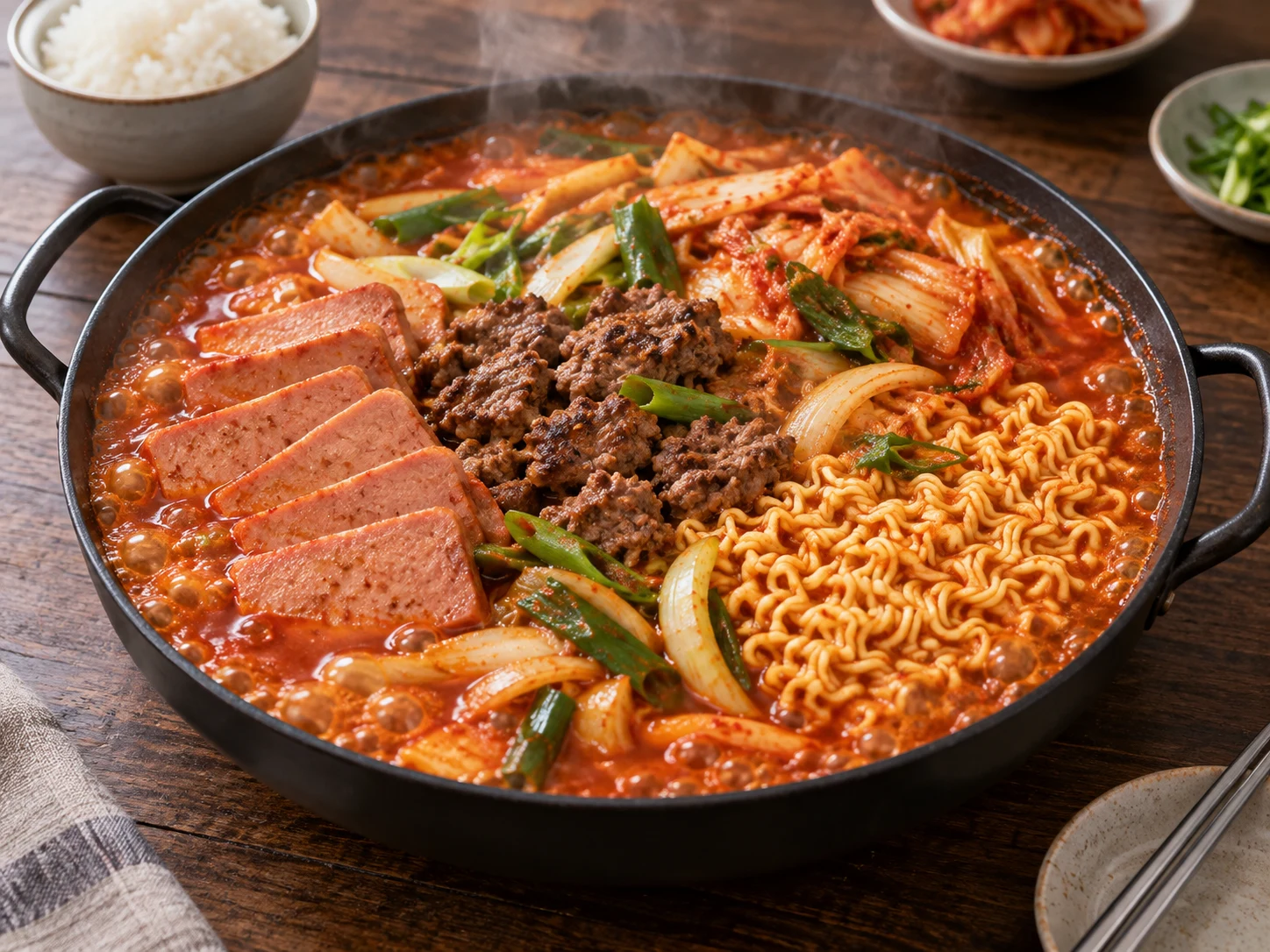
Sour kimchi, canned luncheon meat, and crumbled Korean hamburger steaks bubble in a fiery gochujang beef-bone broth, with springy ramen added at the table.
Editorial guidance updated September 16, 2026 · Not a claim of kitchen testing
QUICK ANSWER
What to know before you cook
Sour kimchi, canned luncheon meat, and crumbled Korean hamburger steaks bubble in a fiery gochujang beef-bone broth, with springy ramen added at the table.
Hambak Budae-jjigae (함박부대찌개) takes about 30 minutes and makes 4 servings. It is rated easy and the finished dish is hot as written, with 4 tablespoons gochugaru, 2 tablespoons gochujang, spicy ramen powder, and kimchi. For medium heat, use 2 tablespoons mild gochugaru and one-third of the ramen powder. For mild, use 1 tablespoon mild gochugaru, 1 tablespoon gochujang, and omit the ramen powder; add a little unsalted stock if reducing those salty seasonings.
The key cooking cue: Even slices soften at the same rate. The hamburger steaks must be fully cooked packaged patties; if yours are raw, cook beef or pork separately to 160°F/71°C, or poultry to 165°F/74°C, before starting the stew.
WHY THIS DISH MATTERS
A little cultural context
Budae-jjigae, literally “army-base stew,” developed in the lean years after the Korean War around U.S. military bases, where imported canned meats met Korean kimchi, chile seasonings, and communal hot-pot cooking. Hambak is Korea’s seasoned hamburger steak. This modern broadcast variation crumbles ready-cooked hambak into the broth, giving a familiar dish a looser, almost minced-meat texture while keeping the classic luncheon meat and ramen.
INGREDIENTS
What you'll need
Both systems are shown so you can cook without converting.
COOKING WEBTOON
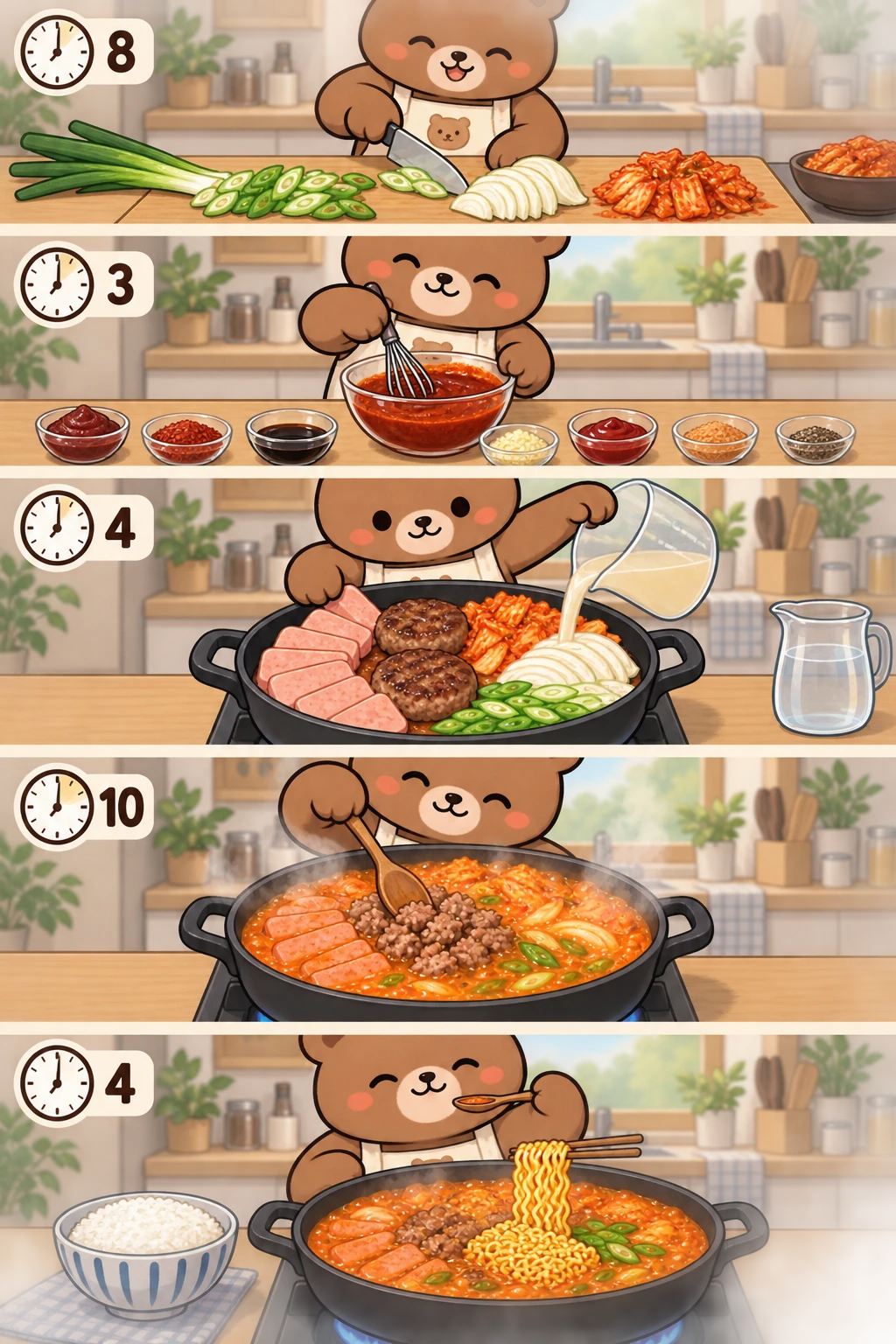
Cook it panel by panel
A quick visual memory guide for the whole recipe.
 1
1Slice the vegetables
8 minSlice the green onion diagonally, thinly slice the onion, and cut the sour kimchi into bite-size pieces.
- 2
Mix the red seasoning
3 minStir the gochujang, gochugaru, soy sauce, garlic, ketchup, half the ramen seasoning packet, and pepper into a paste.
- 3
Build the cold pot
4 minArrange luncheon meat, hamburger steaks, kimchi, onion, and green onion in a wide pot, then add the seasoning, bone broth, and water.
- 4
Boil, crumble, and simmer
10 minAt a full boil, break the hamburger steaks into coarse crumbles. Stir in the seasoning and simmer briskly until the onion is tender.
- 5
Taste and add ramen
4 minTaste before adding salt. Cook the noodle block in the bubbling broth, turning once, just until the strands are springy.
AI-assisted illustration. Follow the written recipe below for exact measurements, sodium adjustments, heat settings, and safe reheating.
DIRECTIONS
How to make it
- 01
Slice the vegetables and kimchi · 8 minutes
Cut the green onion on a 1/4-inch/6-mm diagonal. Thinly slice the onion from pole to pole, then cut the sour kimchi into 1-inch/2.5-cm pieces. Slice the luncheon meat about 1/4 inch/6 mm thick. Keep the frozen hamburger steaks whole for now.
- 02
Mix the seasoning paste · 3 minutes
Stir the gochujang, gochugaru, soy sauce, garlic, ketchup, half of the ramen seasoning packet, and pepper in a small bowl until no dry chile pockets remain. The paste will be thick.
- 03
Arrange the cold pot · 4 minutes
In a wide, shallow 12-inch/30-cm pot, arrange the luncheon meat, whole hamburger steaks, kimchi, onion, and green onion in separate sections. Spoon the red seasoning into the center. Pour the beef-bone broth and water around the ingredients so the neat arrangement stays visible.
- 04
Boil, crumble, and simmer · 10 to 12 minutes
Set the uncovered pot over medium-high heat. It should reach a full boil in 4 to 6 minutes, with bubbles breaking across the center rather than only at the rim. Break each hamburger steak into coarse, bite-size crumbles with a spoon, then stir the seasoning through the broth. Reduce to medium and keep a lively but controlled simmer for 10 minutes. The stew is ready when the onion is translucent, the kimchi bends easily, the sauce tastes integrated rather than floury, and every reheated meat piece is steaming hot; packaged meats should reach 165°F/74°C.
- 05
Taste, turn the ramen once, and serve · 4 minutes
Taste the broth first; dilute with 2 to 4 tablespoons hot water if it is too salty or intense. For ramen, move some solids aside and press the noodle block halfway into the bubbling broth. Cook over medium for 2 minutes, turn it once with tongs, then cook 1 to 2 minutes more while loosening the strands. Stop when they bend freely but still feel springy in the center. Serve the stew bubbling hot with rice.
COOK WITH CONFIDENCE
Fix common problems
Use the symptom, likely cause, and rescue step while you cook.
The broth is too salty
Likely causeLuncheon meat, patties, kimchi, ramen powder, soy sauce, and packaged broth all contributed sodium.
How to fix itAdd hot water or unsalted stock 2 tablespoons at a time and bring the pot back to a simmer. Next time, choose unsalted broth, use one-third of the ramen powder, and hold back 1 tablespoon soy sauce until the final taste.
The broth tastes raw or chalky
Likely causeThe thick seasoning paste did not fully dissolve or the stew only reached a weak edge simmer.
How to fix itStir from the center and simmer uncovered for 3 to 5 minutes, until bubbles break across the pot and the red broth looks uniform and glossy.
The ramen is swollen and soft
Likely causeIt was added before the diners were ready or left sitting in the hot broth.
How to fix itLift the noodles into serving bowls immediately. For leftovers, discard over-soft noodles, reheat the stew with a little water, and cook a fresh noodle block only after it returns to a boil.
SHOP & SUBSTITUTE
Cook it anywhere
Ingredient swaps
Korean hamburger steaksUse two fully cooked Salisbury-steak patties, plain beef burger patties, or beef-and-pork meatballs totaling about 10 to 12 ounces/300 g. Cook raw beef or pork separately to 160°F/71°C, or poultry to 165°F/74°C, before it enters the stew.
Canned luncheon meatUse any canned pork luncheon meat. If only a 12-ounce/340-g can is sold locally, one can is sufficient; slice it thinly and taste before adding more soy sauce.
Beef-bone brothUse unsalted beef or chicken stock. For a little more body, dissolve 1/2 teaspoon unflavored gelatin in the cold stock before heating.
Sour napa cabbage kimchiUse a vegan or fish-free kimchi if needed. If the kimchi is young and mild, add 1 teaspoon unseasoned rice vinegar to the finished broth.
Korean instant ramenUse another 4-ounce/110-to-120-g wheat instant-noodle packet. Begin with one-third of its seasoning sachet because brands vary greatly in salt and chile.
GochugaruUse mild Korean chile flakes, not cayenne. For less heat, reduce the amount rather than replacing it with a different hot chile powder.
Korean pantry guide
A fermented Korean red-chile paste that brings savory depth, sweetness, salt, and body to stews.
Search: Korean fermented red pepper paste gochujangKorean red pepper flakes with a fruity flavor and moderate heat. Coarse or medium flakes suit this stew better than fine powder.
Search: Korean red pepper flakes gochugaruA dark Korean brewed soy sauce used for marinades, braises, and bold stews; salinity differs by brand.
Search: Korean brewed soy sauce jin ganjangWell-fermented kimchi with a clean sour edge. Its acidity keeps a rich meat-and-chile broth lively.
Search: well fermented sour napa kimchi sin kimchiMilky Korean stock made by long-simmering beef bones. Shelf-stable pouches and concentrate tablets are common overseas.
Search: Korean beef bone broth sagol yuksu pouchA sturdy, aromatic allium with a broad white stem and robust green top; both parts flavor the stew.
Search: Korean large green onion daepaServe it with
- Hot Korean short-grain rice
- A crisp cucumber or lettuce salad
- Mild banchan such as steamed egg or bean-sprout namul
Spice level
Hot as written, with 4 tablespoons gochugaru, 2 tablespoons gochujang, spicy ramen powder, and kimchi. For medium heat, use 2 tablespoons mild gochugaru and one-third of the ramen powder. For mild, use 1 tablespoon mild gochugaru, 1 tablespoon gochujang, and omit the ramen powder; add a little unsalted stock if reducing those salty seasonings.
Storage & serving
Remove any ramen you plan to save before it becomes soft. Refrigerate the cooled stew in a shallow airtight container within 2 hours and keep for up to 3 days. Reheat only the portion you need in a saucepan over medium heat for 5 to 7 minutes, adding a splash of water and stirring often, until the center reaches 165°F/74°C. Freeze the stew without noodles for up to 1 month; thaw overnight in the refrigerator.
REAL COOK QUESTIONS
Good questions, clear answers
Short answers for substitutions, heat level, make-ahead cooking, and serving.
What can I substitute for Korean hamburger steaks in Hambak Budae-jjigae (함박부대찌개)?
Use two fully cooked Salisbury-steak patties, plain beef burger patties, or beef-and-pork meatballs totaling about 10 to 12 ounces/300 g. Cook raw beef or pork separately to 160°F/71°C, or poultry to 165°F/74°C, before it enters the stew.
Is Hambak Budae-jjigae (함박부대찌개) spicy?
Hot as written, with 4 tablespoons gochugaru, 2 tablespoons gochujang, spicy ramen powder, and kimchi. For medium heat, use 2 tablespoons mild gochugaru and one-third of the ramen powder. For mild, use 1 tablespoon mild gochugaru, 1 tablespoon gochujang, and omit the ramen powder; add a little unsalted stock if reducing those salty seasonings.
Can I make Hambak Budae-jjigae (함박부대찌개) ahead of time?
Remove any ramen you plan to save before it becomes soft. Refrigerate the cooled stew in a shallow airtight container within 2 hours and keep for up to 3 days. Reheat only the portion you need in a saucepan over medium heat for 5 to 7 minutes, adding a splash of water and stirring often, until the center reaches 165°F/74°C. Freeze the stew without noodles for up to 1 month; thaw overnight in the refrigerator.
What should I serve with Hambak Budae-jjigae (함박부대찌개)?
Serve it with Hot Korean short-grain rice, A crisp cucumber or lettuce salad, Mild banchan such as steamed egg or bean-sprout namul.
KEEP COOKING
Related Korean recipes
Chosen by shared ingredients, pantry staples, and cooking style.